Difficulty Swallowing: Why Food Feels Stuck in Your Throat or Chest
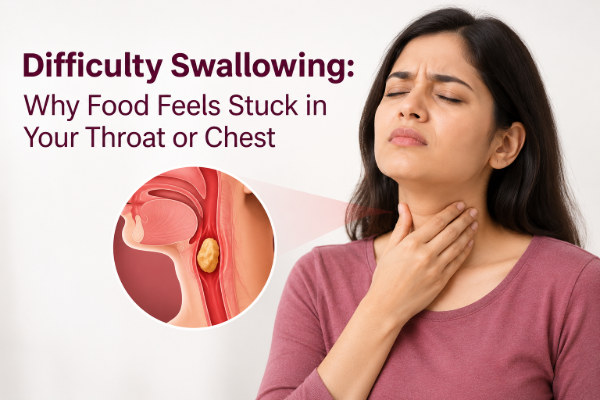
A meal usually follows a simple sequence: food enters the mouth, gets chewed, and travels down the food pipe into the stomach. Most people never think about this process because swallowing happens naturally.
But what happens when a bite of bread seems to stop halfway down? What if drinking water suddenly becomes difficult, or food repeatedly feels as though it is getting stuck behind the breastbone?
These experiences can be signs of a condition called dysphagia, or difficulty swallowing.
Dysphagia is not a disease in itself. It is a symptom that can arise from problems affecting the muscles, nerves or structures involved in swallowing. Some causes are relatively straightforward, while others require a more detailed investigation.
Understanding where the difficulty occurs, which foods trigger it and whether the problem is progressing can help explain why swallowing symptoms deserve attention.
What Is Dysphagia?
Dysphagia is the medical term for difficulty moving food, liquids or saliva from the mouth into the stomach.
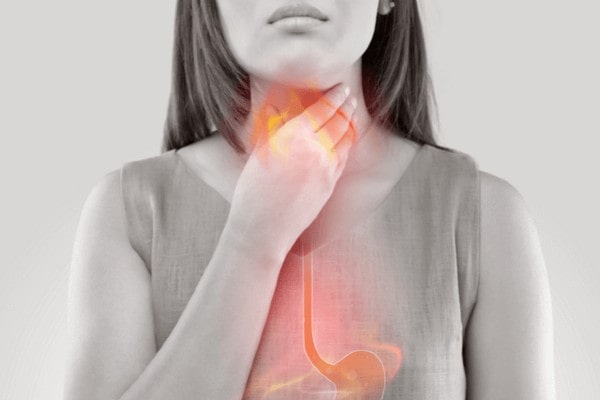
Swallowing involves the coordinated action of muscles and nerves in the mouth, throat and oesophagus. The oesophagus, commonly called the food pipe, carries swallowed material towards the stomach through carefully coordinated muscular contractions.
When any part of this process does not work properly, swallowing may become uncomfortable, slow or difficult.
People with dysphagia may describe the experience in different ways:
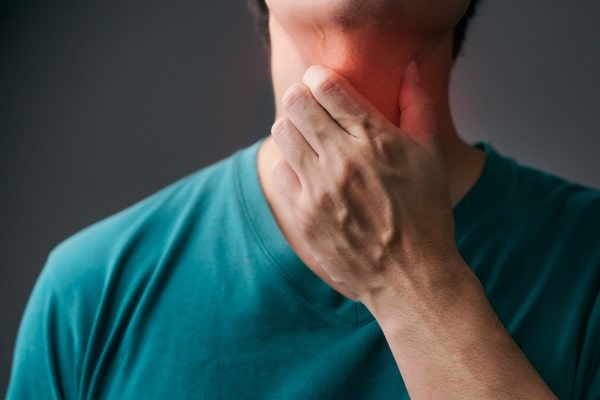
- Food feels stuck in the throat.
- A bite seems to stop in the chest after swallowing.
- Solid food takes longer than usual to go down.
- Drinking water causes coughing or choking.
- Swallowing requires repeated attempts.
- Food or liquid comes back into the mouth.
The location where a person feels food getting stuck does not always identify the exact location of the underlying problem. Clinical assessment helps distinguish between difficulties originating in the throat and those involving the oesophagus.
Two Types of Swallowing Difficulty You Should Know About
Dysphagia is commonly divided into two broad categories. Understanding the distinction helps explain the different conditions that may cause it.
1. Oropharyngeal dysphagia: Difficulty starting a swallow
This type affects the process of moving food from the mouth through the throat.
Possible symptoms include:
- Difficulty initiating a swallow.
- Coughing or choking while eating or drinking.
- Food or liquid coming through the nose.
- A wet or gurgling voice after swallowing.
- Repeated swallowing attempts to clear a mouthful.
Oropharyngeal dysphagia may occur with neurological conditions, muscle disorders or structural abnormalities affecting the mouth and throat.
Because swallowing difficulties in this area can allow food or liquid to enter the airway, they may increase the risk of aspiration and related lung complications.
2. Oesophageal dysphagia: Food feels stuck after swallowing
Oesophageal dysphagia occurs when food or liquid has difficulty travelling through the oesophagus towards the stomach.
People may describe it as a sensation of food becoming lodged in the lower throat or chest.
Possible features include:
- Solid food repeatedly getting stuck.
- Difficulty swallowing both solids and liquids.
- A sensation of pressure behind the breastbone.
- Food returning into the mouth.
- Swallowing taking longer than usual.
Several conditions can cause oesophageal dysphagia, including narrowing of the oesophagus, inflammation and disorders affecting its muscular movement.
Although the sensation may resemble ordinary indigestion, persistent difficulty swallowing should not automatically be attributed to acidity.
Why Does Food Get Stuck in the Food Pipe?
The oesophagus must remain open enough for food to pass through while coordinating muscular contractions that move it towards the stomach.
Different conditions can interfere with this process.
1. Achalasia: When the food pipe struggles to empty
Achalasia is an uncommon oesophageal movement disorder in which the normal muscular activity of the oesophagus is impaired and the lower oesophageal sphincter does not relax properly during swallowing.
The lower oesophageal sphincter is the muscular valve between the oesophagus and stomach.
When it fails to relax adequately, food and liquids may accumulate in the oesophagus rather than passing easily into the stomach.
Common features include:
- Difficulty swallowing both solid foods and liquids.
- Regurgitation of undigested food.
- Chest discomfort.
- A feeling that meals are taking unusually long to pass.
- Weight loss in some cases.
Symptoms may develop gradually, and achalasia can sometimes be mistaken for acid reflux or another digestive condition.
Specialised investigations, such as oesophageal manometry, help assess the muscular coordination and pressure patterns involved in swallowing.
2. Oesophageal stricture: Narrowing of the food pipe
An oesophageal stricture is a narrowing of the oesophagus that makes it more difficult for food to pass through.
One possible cause is long-standing gastro-oesophageal reflux disease, in which repeated exposure to stomach contents can contribute to inflammation and scar formation.
Other causes include certain injuries, previous procedures, radiation-related changes and other diseases affecting the oesophageal wall.
A common pattern is difficulty swallowing solid foods, particularly when the narrowing becomes significant.
People may notice that meat, bread or other dense foods are more difficult to swallow than liquids.
The nature of the narrowing and its underlying cause need to be established before appropriate management can be considered.
3. Eosinophilic oesophagitis: An inflammatory condition
Eosinophilic oesophagitis, often abbreviated as EoE, is a chronic immune-mediated inflammatory condition affecting the oesophagus.
It involves the accumulation of eosinophils, a type of white blood cell, within the oesophageal lining.
Possible symptoms include:
- Difficulty swallowing solid foods.
- Recurrent episodes of food becoming lodged.
- A need to chew excessively or eat slowly.
- Avoiding certain textures because they are difficult to swallow.
- Chest discomfort associated with eating.
The condition can occur in adults and children and is associated with allergic conditions in some individuals.
An upper gastrointestinal endoscopy with oesophageal biopsies is generally important for establishing the diagnosis. The oesophagus may appear abnormal during endoscopy, but it can also look relatively normal despite the presence of the disease.
4. Gastro-oesophageal reflux disease and inflammation
Gastro-oesophageal reflux disease (GERD) occurs when stomach contents repeatedly flow back into the oesophagus and cause troublesome symptoms or complications.
Heartburn and regurgitation are common features. In some cases, reflux can cause inflammation of the oesophageal lining, known as oesophagitis.
Persistent inflammation may sometimes lead to narrowing and swallowing difficulties.
However, not everyone with reflux develops dysphagia, and new difficulty swallowing should not simply be assumed to be another symptom of acidity.
Other causes of oesophageal inflammation may also need consideration, depending on the history and investigation findings.
5. Oesophageal rings and webs
An oesophageal ring is a thin, circular narrowing within the oesophagus. An oesophageal web is a thin membrane-like structure that partially narrows its passage.
These abnormalities can interfere with the movement of solid food.
Some people experience intermittent episodes in which a mouthful suddenly becomes stuck, even though swallowing is otherwise normal between episodes.
The frequency and severity of symptoms vary. Endoscopic or other appropriate investigations may help identify these structural changes.
6. Problems affecting the nerves and muscles
Swallowing depends on coordinated muscle movements and signals from the nervous system.
Conditions such as stroke, Parkinson's disease and certain neuromuscular disorders can interfere with this coordination.
Depending on the condition, a person may have difficulty starting a swallow, controlling food in the mouth or moving it safely through the throat.
Coughing, choking, changes in voice quality and recurrent chest infections may provide additional clues.
These symptoms require attention because impaired swallowing can affect both nutrition and airway protection.
Does Difficulty Swallowing Solid Food Mean Something Different From Difficulty Swallowing Liquids?
The type of food or drink that causes difficulty can provide useful information, although it cannot establish a diagnosis on its own.
Difficulty swallowing solids: When solid foods are consistently more difficult to swallow than liquids, a narrowing or other structural problem may be considered. Examples include an oesophageal stricture, ring or other obstructing lesion.
Difficulty swallowing solids and liquids: When both are difficult from the beginning, a movement disorder such as achalasia may be among the possibilities.
Symptoms that progressively worsen: Increasing difficulty, particularly when foods that were previously easy to swallow become difficult, warrants prompt evaluation.
These patterns are not absolute rules. Structural and movement disorders can produce overlapping symptoms, and the history must be interpreted alongside examination and investigation findings.
When Is Difficulty Swallowing a Warning Sign?
Not every swallowing complaint has the same cause or urgency. However, certain features should not be ignored.
Seek prompt medical assessment if you experience:
- Repeated episodes of food getting stuck.
- Swallowing difficulty that is becoming progressively worse.
- Unexplained weight loss.
- Pain when swallowing.
- Persistent vomiting or regurgitation.
- Blood in vomit or evidence of gastrointestinal bleeding.
- Difficulty swallowing accompanied by persistent chest discomfort.
A medical emergency: If food is completely stuck and you cannot swallow saliva, or you are choking or struggling to breathe, seek emergency medical care immediately. Do not attempt to force the obstruction down with additional food or drink.
Sudden difficulty swallowing accompanied by facial drooping, weakness in an arm or leg, or slurred speech may indicate a stroke and requires emergency assessment.
The key distinction is between occasional sensations that resolve and persistent, progressive or severe difficulty that interferes with normal swallowing.
How Is Difficulty Swallowing Investigated?
The appropriate investigation depends on whether the symptoms suggest a problem involving the throat, the oesophagus or the movement of swallowed material.
1. Clinical history and examination
The initial assessment may explore:
- When the swallowing difficulty first began.
- Whether solids, liquids or both are affected.
- Whether symptoms occur occasionally or with most meals.
- Whether food becomes stuck in the throat or chest.
- Whether coughing or choking occurs during swallowing.
- Whether there has been weight loss or regurgitation.
- Whether there is a history of reflux, neurological illness or previous oesophageal disease.
The clinician may also consider medications, previous procedures and other medical conditions that could contribute to the symptoms.
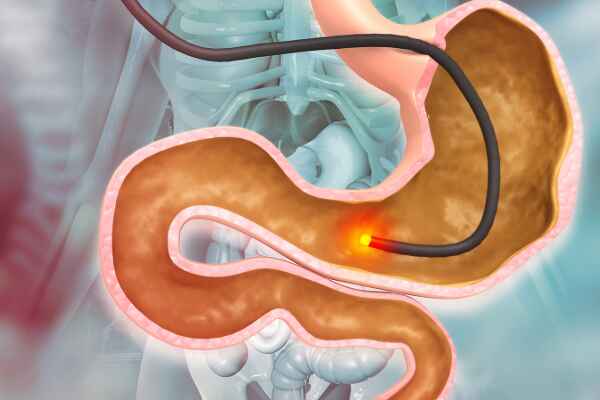
2. Upper gastrointestinal endoscopy
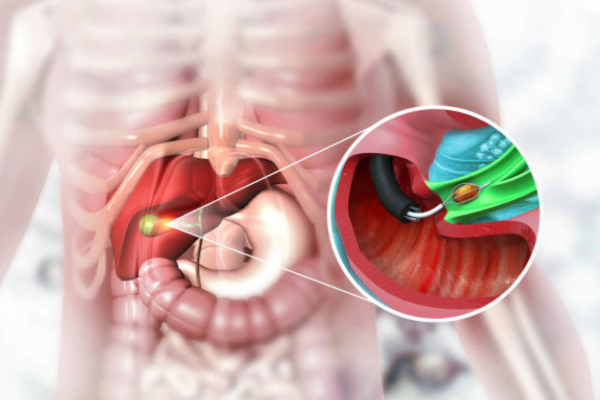
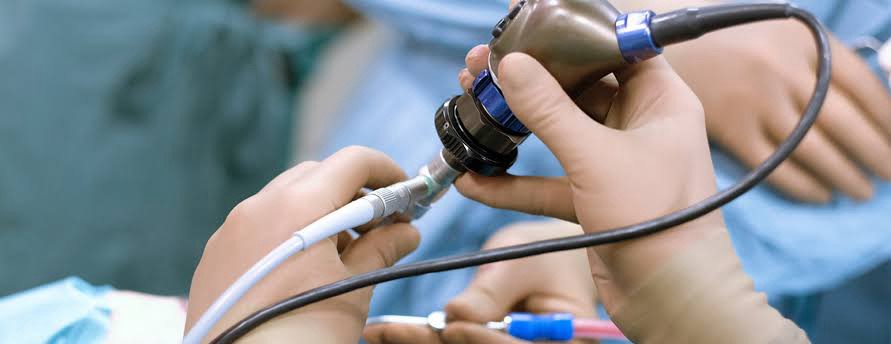
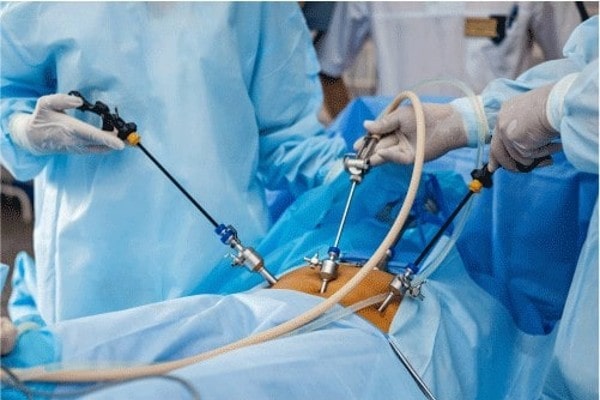
Upper gastrointestinal endoscopy, also known as upper GI endoscopy or oesophagogastroduodenoscopy, uses a flexible instrument with a camera to examine the lining of the oesophagus, stomach and upper part of the small intestine.
It may help identify:
- Narrowing of the oesophagus.
- Inflammation or ulceration.
- Rings or other structural abnormalities.
- Suspicious lesions or growths.
- Features that may suggest a specific inflammatory condition.
Biopsies may be collected when indicated. For example, tissue samples can help evaluate eosinophilic oesophagitis or investigate suspicious changes.
The choice of investigation depends on the symptoms and clinical findings. Endoscopy is not the only test used for every swallowing disorder.
3. Barium swallow study
A barium swallow is an imaging investigation in which a person swallows a contrast material while X-ray images are obtained.
The study can show the shape of the oesophagus, the movement of swallowed material and certain structural or functional abnormalities.
It may be particularly useful in selected cases involving suspected achalasia, narrowing or other problems affecting the passage of food.
A modified barium swallow study is a different examination that focuses on the oral and pharyngeal phases of swallowing, often when difficulty starting a swallow or aspiration is suspected.
4. Oesophageal manometry
Oesophageal manometry measures pressure changes and muscular coordination within the oesophagus during swallowing.
A thin catheter containing pressure sensors is passed through the nose into the oesophagus for the examination.
The test helps assess whether the oesophagus contracts appropriately and whether the lower oesophageal sphincter relaxes normally.
It is particularly useful when a movement disorder, such as achalasia, is suspected or when symptoms remain unexplained after other investigations.
5. Swallowing assessment for throat-related difficulties
When symptoms suggest oropharyngeal dysphagia, a specialist swallowing assessment may be required.
Depending on the clinical situation, this may include a videofluoroscopic swallowing study or a flexible endoscopic evaluation of swallowing.
These investigations help assess how food and liquids move through the mouth and throat and whether material enters the airway.
The investigation pathway should be tailored to the suspected cause rather than applying the same test to every person with swallowing difficulty.
Why Should Persistent Swallowing Difficulty Not Be Mistaken for Acidity?
Acidity and reflux are common digestive complaints. A person who already experiences heartburn may understandably assume that a new swallowing problem is related to the same issue.
However, dysphagia can arise from several different conditions, including structural narrowing, inflammatory disease and oesophageal movement disorders.
The distinction matters because the appropriate investigation depends on the underlying cause.
For example, a movement disorder may require physiological testing, while a narrowing or inflammatory condition may be identified through endoscopy and other investigations.
Persistent or progressive swallowing difficulty is therefore a symptom that deserves specific assessment, even when heartburn or regurgitation is also present.
Difficulty Swallowing in Chennai: Understanding When Gastroenterology Assessment May Help
People living in Chennai may experience swallowing symptoms for many different reasons, ranging from reflux-related inflammation to structural or movement disorders of the oesophagus.
For those searching for information about dysphagia, achalasia, food getting stuck in the chest or upper GI endoscopy in Chennai, understanding the possible causes is an important first step.
Dr. Aditya Shah is a Consultant in Medical Gastroenterology whose professional qualifications include MBBS, MD (General Medicine) and DM (Medical Gastroenterology).
Gastroenterology assessment can help establish whether symptoms may arise from the oesophagus or another part of the swallowing process and whether investigations such as upper GI endoscopy or oesophageal manometry may be relevant.
Patients from areas including Teynampet, Nandanam, Tharamani, Adyar, T. Nagar and Nungambakkam may use these location terms when looking for information about digestive health services in Chennai. Clinic addresses and available services should be verified against the practice's current official details.
Frequently Asked Questions About Difficulty Swallowing
1. What is the medical term for difficulty swallowing?
The medical term is dysphagia. It describes difficulty moving food, liquids or saliva from the mouth into the stomach and can arise from problems involving the throat, oesophagus, muscles or nerves.
2. Why does food feel stuck in my chest after swallowing?
This sensation can occur when food moves slowly through the oesophagus or encounters an obstruction. Possible causes include oesophageal narrowing, rings, inflammation and movement disorders such as achalasia. The sensation alone cannot identify the cause.
3. Can acidity cause difficulty swallowing?
Reflux can cause oesophageal inflammation and, in some cases, scarring and narrowing. However, dysphagia can also occur for reasons unrelated to reflux. Persistent or progressive swallowing difficulty warrants assessment rather than being automatically attributed to acidity.
4. What is the difference between dysphagia and odynophagia?
Dysphagia means difficulty swallowing. Odynophagia means painful swallowing. The two symptoms can occur together, but they describe different experiences and may have different underlying causes.
5. Why can I swallow liquids but struggle with solid food?
Difficulty with solid food can occur when the oesophagus is narrowed or when food encounters a structural obstruction. However, the symptom pattern is not diagnostic on its own, and other causes may need consideration.
6. What is achalasia, and how does it affect swallowing?
Achalasia is an oesophageal movement disorder in which the normal movement of the food pipe is impaired and the lower oesophageal sphincter does not relax adequately. It can cause difficulty swallowing solids and liquids, regurgitation and chest discomfort.
7. Is upper GI endoscopy used to investigate swallowing problems?
Yes. Upper GI endoscopy allows direct examination of the oesophagus and upper digestive tract. It may help identify inflammation, narrowing, rings or other abnormalities, and it allows biopsies to be collected when indicated.
8. Can difficulty swallowing be related to a neurological condition?
Yes. Conditions affecting the brain, nerves or muscles can disrupt the coordinated process of swallowing. Stroke and Parkinson's disease are examples of conditions that can be associated with swallowing difficulties.
9. Is difficulty swallowing always a sign of a serious disease?
No. The causes vary, and the presence of dysphagia does not automatically mean a serious disease is present. Nevertheless, persistent, progressive or recurrent symptoms should be assessed because some causes require specific investigation and management.
10. When should difficulty swallowing be treated as an emergency?
Inability to swallow saliva after food becomes stuck, choking, breathing difficulty or sudden swallowing difficulty associated with possible stroke symptoms requires emergency medical assessment.
11. Which doctor evaluates persistent difficulty swallowing?
Depending on the symptoms, assessment may involve a gastroenterologist, an ear, nose and throat specialist, a neurologist or a swallowing specialist. A gastroenterologist may be involved when the oesophagus or upper digestive tract is suspected to be responsible.
12. Can dysphagia cause weight loss?
Yes. Difficulty swallowing may reduce food intake, lead to avoidance of certain foods or interfere with adequate nutrition. Unexplained weight loss alongside dysphagia warrants prompt evaluation.
Conclusion: Swallowing Should Not Become a Daily Struggle
Swallowing is a coordinated process involving the throat, oesophagus, muscles and nerves. When food repeatedly feels stuck, swallowing becomes progressively difficult or liquids cause coughing and choking, the symptoms should not be dismissed as ordinary indigestion.
Dysphagia can arise from several different conditions, including oesophageal narrowing, inflammation, achalasia and neurological disorders. A careful clinical assessment helps determine which investigations may be appropriate.
Recognising the difference between occasional discomfort and persistent swallowing difficulty can help people understand when further evaluation is important and why identifying the underlying cause matters for digestive health.
About Dr. Aditya Shah
Dr. Aditya Shah is a Consultant in Medical Gastroenterology with qualifications in MBBS, MD (General Medicine) and DM (Medical Gastroenterology). His professional profile and current clinical affiliations can be found in the doctor information section of this website.